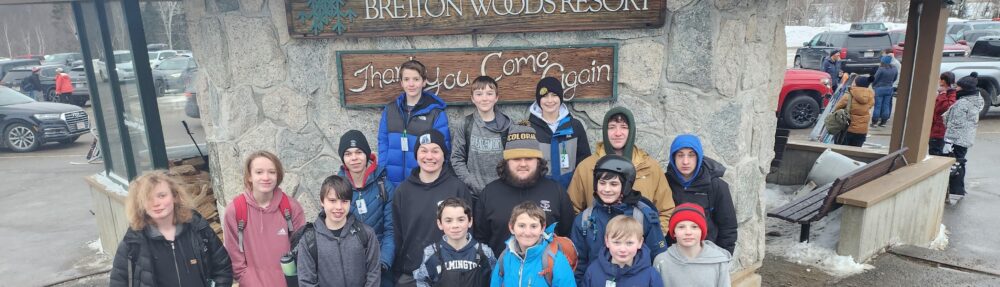
Troop 56 – Information for New Scouts & Parents
We have
prepared this information handout in an effort to provide
some basic information that will be helpful to new scouts
and their parents. It will not answer all of your
questions, so please don't hesitate to look at the Troop
Handbook available online at
http://www.troop56.com. You
call the New Scout Coordinator, Brian MacDonald, at 978
988-0698 (Home) or 978 397-0225 (Cell); the Scoutmaster,
Greg Monteforte, at 978 658-1866 (Home) or 978 815-7169
(Cell); or the Troop Committee Chairman, George Breslin, at
978 658-2692.
Meetings
The
Scouts meet regularly every week on Tuesday nights at
6:30pm at the Congregational Church on Middlesex Street. If
there is no school on a Tuesday (school vacation, snow day,
etc.), then there is no Scout meeting that night. Troop
meetings and outings are not held during the summer.
The period from 6:30-7:00pm is reserved for advancement.
ANY Scout who is ready to be checked out on a requirement
should seek out an adult leader at this time. The Scout
Meeting will officially open at 7:00pm. Scouts should
ALWAYS bring a notebook, pen, and Boy Scout Handbook to the
meetings. All Scouts are required to be in uniform (Class A
or Class B, more information about that below) at meetings.
Fees
Each
Scout pays $5.00 per month in dues for the months of
September through May, 10 months total. This fee covers all
the troop expenses except the cost of outings. The cost for
outings is paid by those attending the outing on a cost
basis. The troop also has fundraisers throughout the year
to help purchase new camping equipment, etc.
We expect that the Scout earns his $5.00 each month by
doing chores around the house. Our philosophy is that the
boys need to take responsibility to earn the $5.00 and for
remembering to bring it to the meeting to pay their dues.
Parents, please do not write out a check for the year.
Uniforms
Each
Scout should have a Class A and a Class B uniform. The
Class A uniform consists of an official scout shirt and
neckerchief or bolo tie. Official scout pants and/or shorts
are not necessary. We recommend that the short sleeve shirt
be purchased as it can be worn over a long sleeve, solid
color jersey in the winter. Required insignia on the
uniform comprises of:
•
Council
Patch (We are part of the Yankee Clipper Council)
•
Unit
Number (We are Unit 56)
•
International
scouting emblem
•
Red
shoulder loops
•
Badge of
Rank (Scout, Tenderfoot, ...), if he has received one
•
Patrol
patch, if he has received one
You
should consult the Boy Scout Handbook for placement of the
insignia. All of this may be purchased at one of the local
Boy Scout Shops (Woburn, Middleton, etc.). Additional
information about location and directions to these shops is
available online at the troop website,
http://www.troop56.com.
A Class B uniform will be given to your son when he reaches
the rank of Scout. The class B uniform is a black or gray
T-shirt with the troop logo in red.
Each Scout should wear his Class A uniform to the third
meeting of the month, to all Court of Honors, and when we
travel. He may also wear it to other meetings and
activities as he sees fit.
Each Scout may wear his Class B uniform during all other
troop meetings and functions.
Advancement
When a
Scout first joins the troop, he works on his Scout rank.
This is the first rank as is easily attained. Typically,
this can be done in his first few meetings. There will be
Troop Guides, experienced Scouts that are already members
of the troop, that will work with the new Scout to help him
attain the rank of Scout. After reaching the rank of Scout,
the Scout will work on attaining new ranks, first
Tenderfoot, then Second Class, and finally First Class.
Although these ranks must be received in order, the
requirements for ANY of the ranks can be worked on at any
time (i.e. A Scout working on Tenderfoot could also pass
requirements for Second and/or First Class). As the Scout
works on the requirements for each rank, he should record
them in his Boy Scout Handbook.
Once a Scout has completed all of the requirements for a
rank, the last three things he needs to do is have a Peer
Review, a Scoutmaster Conference, and a Board of Review.
The last two are listed in the Boy Scout Handbook but the
first is not. The Peer Review is an opportunity for the
Scout to have one of his peers, a Scout at or above the
rank of First Class, review all of the requirements with
the Scout. Once the Peer Review is complete, the Scout
should schedule a meeting with the Scoutmaster, the
Scoutmaster Conference. Scoutmaster Conferences are
conducted during the period between 6:30-7:00pm each
Tuesday that there is a Scout meeting. The Scout must wear
his Class A uniform to the Scoutmaster Conference. After
the Scoutmaster Conference, the Scout should look to
schedule a Board of Review. The dates available for a Board
of Review are posted weekly during the meeting. If you have
any questions about scheduling a Board of Review, just see
one of the adult leaders at a meeting.
The troop encourages each Scout to advance to the rank of
First Class in their first year of scouting (i.e. By the
end of 6th
grade).
However, to accomplish that, it is necessary for the Scout
to be active in the troop as one requirement of reaching
First Class is that the Scout must attend 10 troop outings,
three of which must be overnight camping trips that involve
sleeping outdoors. Each Scout should keep their own
advancement record by keeping their Boy Scout Handbook,
signed Merit Badge blue cards, and rank cards received upon
completion of a rank in a safe place. This may be needed as
a backup to the troop records in case of any questions.
Merit
Badges and Blue Cards
Once a
Scout has reached the rank of First Class, much of his
advancement effort will involve obtaining Merit Badges.
Work on a Merit Badge begins with the Scout informing his
Scoutmaster that he intends to work on a badge. The
Scoutmaster gives the Scout a Blue Card for recording
progress on the badge and gives the Scout the name of the
Merit Badge counselor. When all the requirements for the
Merit Badge have been completed, the Scout will return the
Blue Card signed by his counselor. Attaining the rank of
Star (the next rank after First Class) requires completion
of 6 Merit Badges of which 4 must be from the Eagle
required group. Next comes the rank of Life which requires
an additional 5 (for a total of 11) Merit Badges including
3 more from the Eagle required group. In order to obtain
the final rank, Eagle, requires an additional 10 (for a
total of 21) Merit Badges including 5 more from the Eagle
required group (for a final total of 12).
The Troop will work on some Merit Badges as a troop and
others will be offered on an optional basis during
advancement sessions at troop meetings. However, it is
expected that each Scout will work independently of the
troop on MOST of the Merit Badges. One excellent
opportunity to work on Merit Badges, as well partake in an
overnight camp outing, is Summer Camp.
Summer
Camp
The
troop goes together as a troop to Camp Wha-Tut-Ca. The camp
is located in Northwood, NH and is owned by the Boy Scouts.
The troop typically goes during the third full week in
July.
Outings
The
troop goes on about one outing per month during the school
year. Few Scouts can attend all the outings but we
recommend that a Scout attempt to attend as many as
possible. It is on outings that Scouts have the most fun
and learn the most about outdoor skills. Advancement to
Second Class requires attending five outings while
advancement to First Class requires an additional five (for
a total of 10).
Permission slips are required for all troop outings. These
permission slips will be made available several weeks
before any outing on the troop website,
http://www.troop56.com.
Camping
Gear
The
troop does a lot of camping and other outdoor activities so
there is some essential equipment that each boy needs such
a a daypack, sleeping pad, and sleeping bag. A good start
on a list of basic outdoor equipment needed is:
1. Good
pair of hiking shoes or boots and several pairs of socks
Be sure
to “break them in” before your first hike!
2.
Canteen or water bottle (1 quart minimum)
Nalgene
bottles work great. The new “Hydration packs”
are popular but not necessary yet
3. Mess
kit and “silverware” (stainless or plastic
preferred)
Think
about labeling it so you can distinguish it other ones that
may look the same
4.
Sleeping bag (rated 25 degrees F) and a closed cell pad
A 0
degree rated bag is required for snow camping
5.
Flashlight (small)
2 -AA
batteries is a good size. A folding stand is handy.
6.
Backpack
A good
backpack can be expensive. Check out the different
styles/sizes and think about borrowing one for a while.
7. Rain
suit or poncho
A low
cost “emergency” style poncho is light and
small but very useful
8.
Toilet Kit
You can
make this kit yourself using the lists in your Boy Scout
Handbook
9. First
Aid Kit – personal
You can
also make this kit yourself using the lists in your Boy
Scout Handbook
10.
Compass
You will
be doing lots of map reading so get a compass that lies
flat with clear see thru scales.
11.
Pocketknife (after Totin' Chip is earned)
Folding
type, 3” maximum blade length, lock blade preferred
12.
Waterproof matches (after Firem'n Chit is earned)
“Strike
anywhere” matches in a waterproof holder are also OK
It would be best if the gear was appropriate for
backpacking (i.e. Lightweight). You may want to consider
more than one sleeping bag, the first being at least rated
to 0 degrees for the camping in the late fall/winter/early
spring and the other rated to at a higher temperature for
the summer/early fall. Take a look at the Boy Scout
Handbook for another example packing list. If you are not
experienced in buying backpacks, sleeping bags, etc., go to
a store like REI, EMS, Sports Authority, or Hilton Tent
City to get advice. The older Scouts as well as the adult
leaders are also an excellent source of information if you
have any questions regarding the type or style of the above
equipment.
Service
Projects
Advancement
to Second Class, Star, and Life requires completion of a
certain number of hours of work on an approved service
project. Typically, the troop holds organized service
projects each year at which some of the required hours of
service can be obtained. With each rank, the service
project should involve a greater amount of leadership and
planning. Beginning with Star projects, the Scout should
prepare a short, written proposal for his project for
approval. Upon completion, the Scout should prepare a short
report on the project to be presented to the Scoutmaster.
Venture
Crew
The
Venture Crew is a group of Scouts who have a rank of First
Class or higher that commit to participate in planning and
organizing “high adventure” trips for the crew
such as a North Woods Canoe Trip. The Venture Crew will go
on weekend backpacking, rock climbing, canoeing, etc. trips
4 to 5 times a year. These trips are separate from the
trips that involve all the members of the troop.
Scout
Leadership
One of
the principal goals of Boy Scouting is providing an
opportunity for boys to attain leadership skills. The troop
is always working towards the goal of having the troop run
by the Scouts. We continue to make progress toward that
goal but there is always more work to be done. We have
regular meetings of a Patrol Leaders Council (PLC or
Greenbar Meeting) with the hopes that the Scout leaders can
continue to work to take over the planning and much of the
implementation of the troop activities.
We as that most questions about normal troop outing and
functions follow the chain of command of the troop. If a
new Scout has a question, he should ask one of the Troop
Guides or the Scout's Patrol leader, then the Senior Patrol
Leader, and lastly the Scoutmaster. If a situation arises
where you feel the issue is not appropriate to discuss with
the youth leaders, please don't hesitate to contact the
Scoutmaster directly. We ask that all parents work with us
to encourage the boys to be leaders.
Troop
Committee
This
committee is made up of adult leaders and parents. It
handles finances, provides support for th advancement,
training, and outdoor programs of the troop, and is in
charge of recruiting adult leaders and volunteers. George
Breslin is the Chairman of the Committee. The committee is
involved in supporting the planning of troop activities but
the actual planning is the function of the Patrol Leaders
Council and the Scoutmaster. The committee provides adult
support for the activities as needed and performs Boards of
Review for rank advancement. Committee meetings are held on
the second Monday of each month at 7:00pm and the
Congregational Church.
Parent
Involvement
We have
no strict rules about parent support of the troop's program
but the involvement of parents is vitally important to the
troop. We need your involvement in supporting your Scout,
supporting his rank advancement, supporting his attendance
to the troop meetings, and supporting his participation in
the troop activities. Parent volunteers are needed as
Assistant Scoutmasters, Troop Committee Member, Merit Badge
counselors, to attend outings, etc. Any and all help you
can offer will be greatly appreciated.